


Beyond the trees: See the bigger biological picture with pathway enrichment analysis
Proteomic data holds enormous potential—but the biology is rarely contained in a single protein. When you’re handed a list of differentially abundant proteins, the next challenge is turning that list into a clear, testable story about mechanisms and processes.
In this webinar, you’ll learn how pathway enrichment analysis translates protein-level results into pathway-level insight, helping you “see the forest for the trees.” You’ll learn core enrichment concepts, how to choose an approach that fits your study design, and how to interpret results to prioritize biology for downstream research.
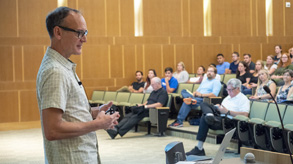
In this session, Julián Candia, PhD, staff scientist at the National Institutes of Health (NIH), shares practical guidance for applying pathway enrichment analysis to real proteomics studies, including how the SomaModules database supports pathway-level interpretation.
Through practical examples, you’ll learn best practices for pathway enrichment analysis, including background selection, multiple testing correction, pathway redundancy, and reporting. By the end of the session, you’ll be better equipped to move from long lists of differentially abundant proteins to prioritized biological mechanisms and stronger hypotheses for downstream research.
By the end of this session, you will be able to:
- Explain what pathway enrichment analysis is and why it helps you move beyond protein lists
- Compare common enrichment approaches, including strengths, limitations, and when to use each
- Choose practical ways to run pathway analysis that match your team’s skill set (from point-and-click tools to code-based workflows)
- Apply interpretation best practices to identify pathway-level themes that support mechanism and hypothesis generation
- See an end-to-end example of turning enrichment results into a stronger biological narrative for proteomics studies
Speakers:

Julián Candia, PhD
National Institute of Health
Dr. Candia earned undergraduate and doctoral degrees in Physics from the University of La Plata (Argentina). Since 2014, he has been a Staff Scientist at the National Institutes of Health, where he collaborates with basic, translational, and clinical scientists. He applies his expertise at the crossroads of data science, bioinformatics, machine learning, network science, and statistics to contribute innovative ideas to key problems in biomedical research, with special emphasis in human aging applications. To date, he has authored over 120 original research peer-reviewed articles and 3 book chapters. More information available at juliancandia.github.io

Maile Gall, PhD
Illumina
Dr. Mailie Gall is a bioinformatics specialist focused on genomics and proteomics, supporting SomaScan data analysis across the Asia–Pacific region since 2023. Her experience spans research, healthcare, and industry, with an emphasis on large-scale and translational bioinformatics. She has co-authored research published in The New England Journal of Medicine, Nature Medicine, and Nature Communications, and has a broad background in pathogen and cancer genomics, as well as evolutionary and environmental science.

Amanda Hiser, MS
Illumina
Amanda Hiser is a bioinformatics scientist at Illumina. She collaborates with analysts, software engineers, and product teams to translate customer needs into bioinformatic analysis tools and software features.
Amanda received an MS in Bioinformatics and Computational Genomics from the University of Oregon, and previously worked in pediatric oncology research. She joined SomaLogic in 2022, where she specialized in R software development.
Beyond the trees: See the bigger biological picture with pathway enrichment analysis
A presentation by Julián Candia, PhD, Maile Gall, PhD and Amanda Hiser, MS

More webinars
WebinarOpening the black box: Building and evaluating machine learning models for proteomics
Machine learning can be a powerful way to extract multivariate signals from high-dimensional proteomics data, but only when models are built and evaluated with rigor. In this on-demand webinar, explore a practical framework for developing predictive and explanatory models, with an emphasis on study design choices that help prevent data leakage, reduce overfitting, and improve reproducibility.
WebinarFinding the signal: Identifying reproducible biomarkers in high-plex proteomics
In biomarker discovery, the challenge is rarely a lack of data. Rather, it is knowing how to separate meaningful biological signal from technical distraction. This webinar focuses on how to use univariate analysis as a practical and powerful entry point for biomarker discovery in high-plex proteomics studies.
WebinarMore than the sum of its parts: How harmonized proteomic data reveals meaning across disparate clinical cohorts
Proteomics data generated across sites, time points, and workflows can be difficult to compare using standard normalization alone. This webinar shows how harmonization aligns datasets into a shared biological framework and reveals signals across studies and cohorts, highlighted through the GNPC’s analysis of 40,000 patient samples.