




Improve study efficiency, time, and cost
Detect real biological signals earlier with reproducible proteomic data across studies and cohorts
See published clinical evidence
For Research Use Only. Not for Use in Diagnostic Procedures.
What gets in the way of reliable clinical data?
When clinical research data is difficult to compare or interpret, progress slows. Internal reviews take longer, uncertainty increases, and clinical research programs require more time, larger cohorts, and greater investment to reach confident conclusions.
As studies expand across sites, timepoints, and cohorts, small inconsistencies can compound, making it harder to identify true biological signals and maintain momentum across your program.
Technical variability
When assay performance shifts across sites, batches, or timepoints, true biological signals become harder to distinguish and often requiring more samples to achieve confidence – driving up study cost and complexity.
Limited biological interoperability
When signals lack biological context, it becomes harder to understand what is changing and why it matters, or how findings relate across cohorts.
Operational complexity
As studies expand, fragmented workflows and competing demands can slow execution, increase coordination burden, and make data harder to carry across a program.
What enables more reliable clinical research data?
Reliable clinical research data depends on more than measurement alone. Proteomics can help you compare findings across cohorts and timepoints, interpret biology with greater context, detect meaningful patterns earlier in a study, and support more consistent execution as clinical research programs grow more complex.
How proteomics can improve efficiency and confidence in clinical research
Confirm target & pathway effects earlier
Generate biological evidence that supports early internal reviews before your study designs and timelines are locked.
Detect emerging benefit or risk biology sooner
Support faster, better-informed decisions to protect participants, optimize trial design, and reduce late-stage development risk.
Compare data across cohorts and timepoints with confidence
Maintain defensible comparisons as your studies expand, you add sites or move into follow-on work.
Bring review-ready data into governance discussions
Translate complex datasets into interpretable summaries that help answer “is this real?” faster.
Proteomics capabilities that support efficient and reliable clinical research
Clinical research programs require biological insight that is reproducible, interpretable, and operationally practical as studies evolve. Our proteomics capabilities help you detect real biological signals earlier, moving from comprehensive discovery scale measurement to focused follow-up and broader biological context, including immune context – supported by service-enabled workflows that fit real clinical research needs.
Profile over 9,500 unique human proteins across cohorts, sites, and timepoints to support early biological understanding, cross-study comparison, and longitudinal tracking as your clinical research programs progress.
Best for: broad protein coverage, pathway coverage, cross-cohort comparability
Measure your proteins of interest for biomarker validation or pathway-focused research using a targeted approach that builds on earlier findings.
Best for: focused follow-up, program prioritization, continuity from discovery
Assess autoantibody responses to add immune context to support interpretation in studies where immune mechanisms, heterogeneity, or safety signals are relevant.
Best for: immune and autoantibody profiling, immune heterogeneity, added biological context
Gain insight into physiological state and underlying biology through rigorously validated protein signatures across cohorts and timepoints. Use these signatures to support participant stratification research, modeling, and endpoint exploration.
Best for: physiological context, interpretability, early evaluation of biological change
Support interpretation with standardized QC summaries, cohort comparisons, and clear, review ready analyses. These outputs can help you reduce internal analysis burden and accelerate understanding across teams.
Best for: Standardized QC, cohort comparisons, interpretable summaries
Results are for research use only and not for use in diagnostic procedures.
Proof from real clinical research programs
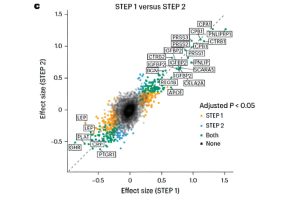
Figure 1. Comparison of effect sizes between two analysis steps (STEP 1 and STEP 2). Each dot represents a protein, demonstrating strong concordance of proteomic signals across analyses, with the most significant proteins exhibiting consistent effect sizes.¹
Reproducible proteomics across independent cohorts without added complexity
Semaglutide STEP 1 vs STEP 2 (Novo Nordisk)
Proteomic treatment responses were highly concordant across two independent clinical research cohorts (STEP 1 and STEP 2) without the need for bridging samples (Figure 1).
This level of comparability helps you interpret results across studies with confidence – reducing the need for additional samples, rework, or complex study design adjustments.
Biological benefit and risk signals observed earlier than traditional endpoints
Torcetrapib (ILLUMINATE study)
Proteomic analysis can surface meaningful biological benefit or risk signals in clinical research well before conventional trial endpoints mature. In post-hoc analysis of torcetrapib, a small-molecule therapy to treat cardiovascular disease (CVD), proteomic risk signals were detected within months of treatment initiation, along with pathway-level biological context consistent with later observed safety outcomes (Figure 2).
Earlier biological insight can help you recognize emerging patterns while a study is still evolving, before timelines, cohorts, and endpoints are fully locked.
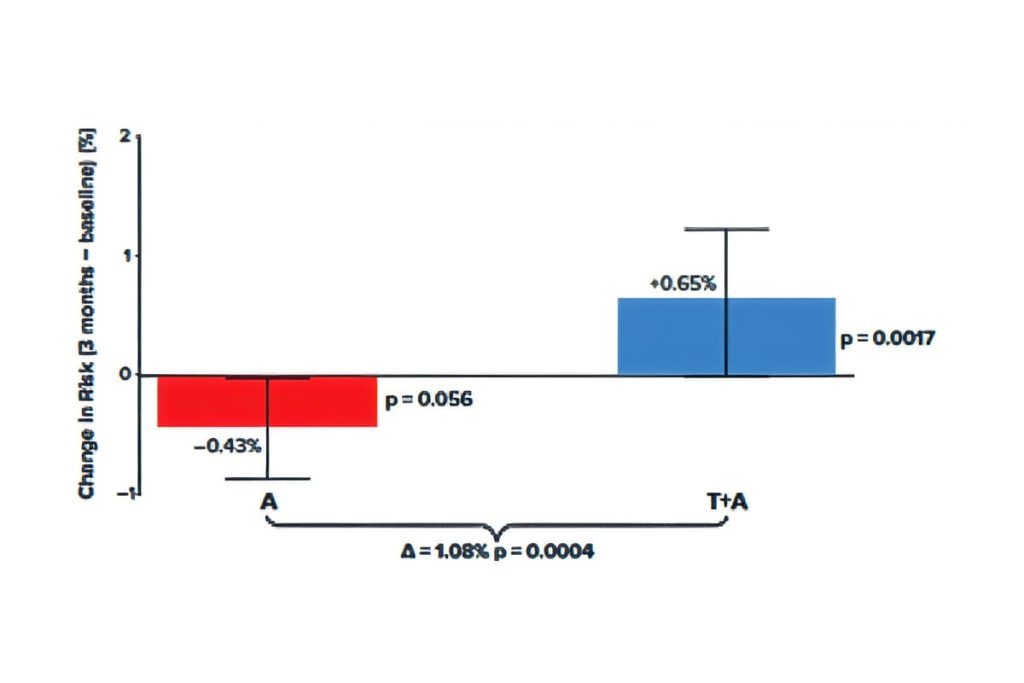
Figure 2. Retrospective analysis using SOMAmer Proteomics to develop a nine-protein CVD risk prediction model. Percent change in risk is shown by treatment group. From baseline to three months, treatment with torcetrapib plus atorvastatin was associated with an increase in the absolute nine-protein risk score.
Clear biological interpretation for internal review and governance
Proteomic pathway analysis can provide mechanistic context, shedding light on early risk signals and unintended biological effects. Examples include aldosterone signaling and insulin sensitivity, which helped clarify observed trends during internal safety and cross-functional discussions.
Pairing observed signals with biological context reduces uncertainty, limits “is this real?” debate, and strengthens confidence during governance and safety assessments.
What this could look like for your clinical research program
Clinical research programs vary by indication, stage, and design. A brief conversation with our scientific team can help you understand how proteomic profiling, interpretation, and service-enabled delivery could support earlier signal detection, reduce variability, and improve efficiency across your study.
Clinical research proteomics: frequently asked questions
How can proteomics support clinical research programs?
Proteomics can help you explore biological changes linked to treatment response, disease progression, participant variability, and biomarker strategies across clinical and translational research studies.
Can proteomics be used for multi-site or longitudinal studies?
Yes. Reproducibility and consistency across cohorts, sites, and timepoints are especially important in multi-site and longitudinal studies, where you need data that remains comparable over time.
Will adding proteomic analysis create more operational burden?
Not necessarily. Service-enabled workflows and expert support can help your teams access advanced proteomic analysis without building internal infrastructure or adding unnecessary complexity.
What types of outputs will I receive?
Outputs may include quality summaries, protein-level results, comparative analyses, and interpretation-ready reporting designed to help you support internal review and next-step decisions.
Can proteomics complement existing biomarker strategies?
Yes. You can use proteomics alongside existing biomarker approaches to add broader biological context and support deeper interpretation.
What sample types are commonly used?
Sample compatibility depends on your study design, but plasma and serum are commonly used in many proteomic research workflows.
Is in-house bioinformatics expertise required?
Not necessarily. Many teams use expert support services to help translate complex datasets into clear, decision-ready outputs.
How do I know if this is a fit for my study?
Study fit often depends on what you want to understand. That can include objectives such as responder biology, cohort heterogeneity, cross-site consistency, translational insight, or how you plan to scale biomarker research across your programs.
References
-
Maretty, L. et al. “Proteomic changes upon treatment of semaglutide in individuals with obesity.” Nature Medicine 31 (2025): 267–277.
-
Williams, S.A. et al. “Improving assessment of drug safety through proteomics: early detection and mechanistic characterization of the unforeseen harmful effects of torcetrapib.” Circulation 137 (2018): 999–1,010.